Monday, March 23, 2009

Ecumenical Advocacy Days

Last weekend I joined a group from LSTC in attending the annual Ecumenical Advocacy Days gathering in Washington DC. “Ecumenical Advocacy Days is a movement of the ecumenical Christian community, and its recognized partners and allies, grounded in biblical witness and our shared traditions of justice, peace and the integrity of creation. Our goal, through worship, theological reflection and opportunities for learning and witness, is to strengthen our Christian voice and to mobilize for advocacy on a wide variety of U.S. domestic and international policy issues.” See advocacydays.org for more info. A young adult group also gathered, see: www.faithconnectsus.com

People from all over the country and from different church bodies came together to attend workshops on a broad range of social issues. On Friday, Saturday and Sunday, we attended plenary sessions and workshops and on Monday we lobbied (primarily on the issue of climate change) on Capitol Hill.

The theme this year was “Enough for all Creation,” focusing on connections between climate change and other global issues like migration and poverty, which were discussed at plenary sessions. The plenary sessions emphasized the interconnectedness of the world, and how global warming and increasingly scarce resources (the global food crisis, etc.) is driving more and more people into grave living conditions. Climate change disproportionately affects poor countries, who have contributed least to the causes of global warming, but will be affected the worst. The disproportionate and excessive emissions from the United States is causing and will continue to cause even greater suffering to people in the world's most vulnerable communities. The plenary speakers emphasized how climate change is a justice issues, and how our faith calls us to advocate just policies that protect the most vulnerable communities and care for all of God's creation.

We also heard from staffers of a few members of Congress (including a staffer of House Speaker Nancy Pelosi) about possible legislation on climate change. They agreed that of the possible options for addressing the issue, a cap and trade system would be the most effective.

There were also different “tracks” which dealt with more specific issues or regions. I went to workshops in the Latin America track, where we learned about issues like the Cuban travel ban, the humanitarian crisis in Colombia, indigenous peoples' rights, drug cartel violence in Mexico, immigration reform, trade agreements, etc.

Participants also met with their various church bodies. We heard from the directors of the ELCA National Policy Staff as well as representatives from Lutheran Services in America, Lutheran Immigration and Refugee Services and Lutheran World Relief. The ELCA is actively involved in advocacy work on a broad range of social issues. To learn more about ELCA advocacy or to receive advocacy e-alerts, see: www.elca.org/advocacy

We heard from Mara Vanderslice, a religious advisor to President Barack Obama, who talked about the White House Office for Faith-Based and Neighborhood Partnerships. Vanderslice explained that the Office’s top priorities will be making community groups an integral part of our economic recovery, fighting poverty, address teen pregnancy and how to reduce the need for abortion, encourage responsible fatherhood (an issue close to Obama's heart), and interfaith dialogue with world scholars and leaders. She boasted the work of the ELCA Washington Office, and the advocacy work Lutherans are engaged in. Participants extended an invitation to President Obama to choose to a Lutheran church for his new church home.

There was a hopeful sentiment from presenters with the possibilities that working with the new Obama administration will bring. At the same time, there was a recognition of the scale of the problems, particularly the economic crisis, facing the nation and world.
We also participated in advocacy workshops which offered tools for our lobby visits. We lobbied with congressional aids to the Senators and House Representatives from our home states. Overall the experience at the Ecumenical Advocacy Days was both daunting given the challenges our we face, but a cause for hope given the active engagement of the church in struggling and advocating for policies that foster a more just and sustainable world.

Wednesday, March 04, 2009

"Ain't No Reason" by Brett Dennen

Chris introduced me to this guy, really good music and strong social messages in the songs. Watch this video.

A brief description of the video from Brett Dennen himself:

"It is our routines and our comforts that allow us to ignore social issues. For some of us, it is our privilege to be ignorant. This video tells the story of social issues challenging our privileges and entering our routines making them impossible to ignore. Social injustice cannot be ignored when you are forced to deal with them. That is the idea behind this video.

What would happen if you were forced to deal with something that you may think has nothing to do with you? If suddenly the world's problems came into your
own home? You would have to realize that you are connected to everything and everyone one earth."

Tuesday, March 03, 2009

letters from prison

On Monday March 9th Kristin Holm a fellow seminarian and friend of mine at the Lutheran School of Theology at Chicago will serve a 2 month sentence at Pekin FCI prison for civil disobedience.
"Kristin Holm is a 21 year old Lutheran seminary student at LSTC (Lutheran School of Theology at Chicago) who was recently arrested while protesting at the Western Hemisphere Institute for Security Cooperation (formerly the School of the Americas) at Ft. Benning, Georgia. The School of the Americas (SOA) has trained some of the worst military dictators in Latin American history, who are responsible for the deaths of hundreds of thousands of innocent men, women and children. Kristin was convicted and sentenced to 60 days in federal prison and a $250 fine. She will be serving her prison sentence with hopes that it will aid in the fight to close down the SOA/WHINSEC."
Please read more and learn how to support Kristin in her fight for a more just world:
http://www.lettersfromprison.com/

Monday, December 15, 2008

Sunday, November 16, 2008

Global perspectives on the U.S. Election

Every Monday students, faculty and staff gather at the LRWC (Language Resource and Writing Center) of the Lutheran School of Theology at Chicago and McCormick Theological Seminary for Global Conversations, which are lunch conversations where students share various international perspectives. Last Monday about a dozen students from all over the world shared their perspectives on the recent election in the United States. Here is a summary of the discussion:

A student from Sudan shared the hope from his country and an e-mail from a Kenyan friend of his, who shared about the pride felt in Kenya because of Obama's Kenyan roots.

A student from Indonesia shared about the pride Indonesians felt, since Obama lived in Indonesia for part of his youth.

A student from El Salvador shared his hope for U.S. relations with El Salvador, and in the struggle to close the School Of the Americas.

A student from Colombia was hopeful that there would be a concern for human rights reflected in the U.S. Policy with Colombia, particularly in the free trade agreement.

A student from Palestine addressed the concern of the Palestinians that the new U.S. President would reflect the same position about Palestine. She shared that many in Israel preferred McCain, and that they are wary of Obama's approach to diplomacy.

We heard from two Indian students that in India there are many who are happy and celebrated Obama's victory, particularly because of the opportunity for someone from an oppressed group to lead the country. We also heard that there are some in India that would like some of the current policies with India to remain the same.

In Nigeria there were great celebrations and gatherings all over the country, a Nigerian student noted, particularly because Obama shares their African heritage. He also noted that Nigeria, with their tribal prejudices, has something to learn from the election of an African American candidate in the U.S.

Then we heard from a student from Russia, who said that Russians were suspicious of the hard-line rhetoric they were hearing from McCain, and saw him as representing an older generation, that of the Cold War. To many Russians, she said, Obama represents the same generation as Putin, a new generation. In general, Russians are naturally pessimistic, she said, but there is hope as well.

We heard from a student from South Korea, who sees a sense of hope in her country. She expressed hope for North Korean relations. She also is hopeful that the U.S. Empire could be more of a human empire. Perhaps there can be a change with those (in Korea) who see the U.S. With an image of a white face.

A student from Turkey says that generally she doesn't feel that the U.S. Cares about what happens in Turkey. She sees hope in Turkey to renegotiate, that Obama won't have cold blood in his relationship.

Overall, the conversation was very informative and insightful. It was a reminder of how the election in the U.S. has an impact in the entire world. There were at times feelings of skepticism, particularly due to the U.S. government's past actions that have scarred international relations and have violated human rights. However, from all of the students there, I heard the word “hope.” The sense of hope was resounding in Obama's message of a new direction, his heritage and understanding of the world, and his diplomatic approach. As we face many serious challenges in the world at this time in history, it was refreshing to hear so much hope.

Monday, July 07, 2008

Internship Newsletter - June 2008

Winter greetings from Argentina. I celebrated my birthday this year with Argentina, since May 25th is one of the independence celebrations here. My internship is going very well, it is hard to believe I really only have about a month left. Looking back, this internship has truly been a great context for me to learn, grow and thrive in ministry. There is a beauty, love, resilience and grit in the people here that I'll always take with me. The members of the congregations and communities have accepted me and have allowed me to walk with them, and it's those encounters that are forming me in pastoral ministry.

Having the two different church communities (MMM, Misión Maria Magdalena -Mary Magdalene Mission- in Resistencia and San Mateo -St. Matthew- in Corrientes) has made my experience broader. I've learned about how small family sized congregations function. The experience teaching and preaching has been particularly valuable. I preach every other week. I'm learning a lot from my pastor's affinity for the type of preaching that keeps the Gospel in one hand and the newspaper in the other. Of course a big question is always, how is text relevant to the context? How do I make 2 years of theological study relevant in ministry? The most valuable lessons I learn are when those questions are answered. In the ministry of presence and listening I have learned a lot about the struggles of the people here, but also the hopes and grace of God in the midst of them.

My Internship Project was to accompany and empower two church leaders in becoming teachers for first communion, so that they would continue in the years to come. I'm learning a lot of tools on how to build up leaders, and how important it is to identify and encourage the gifts in people. We have completed the First Communion class at MMM, and I've been teaching First Communion and Confirmation at San Mateo. I also lead bible studies in Corrientes every other week on the weekly Gospel text.

MMM has been in the process of workshops on Natural Church Development, which encourages congregations to look within themselves, identifying their God-given gifts in order to grow. Through them, we identified the youth group as an area for growth. Since then we've been having frequent meetings, and had a worship service led by the youth, after which they felt empowered in their role in the church. The youth group is currently planning a trip to the interior of the Chaco province, to assist aid organizations in their work in fighting hunger and disease.

Last week at MMM, our beloved member Antonia passed away. She was 72, and she would attend worship almost every week. She was a grandmother to all of us. She had a tender loving spirit, and a deep faith. We had the wake in the chapel, and left it open all night. There were so many people who came to say goodbye to her. At her burial Pastor Raul told a story about a church trip to Iguazu Falls she attended, and how she felt God’s presence in the waterfalls. She saw God’s presence in the big and small, and carried it with her everywhere. She passed away a couple days before we were to have her grandchild’s baptism, giving us all a reminder of the gift of life amidst the sorrow of death.

I have also been involved with the broader Lutheran church body here, the IELU (Iglesia Evangélica Luterana Unida - United Evangelical Lutheran Church). Back in January I helped with 3 weeks of church youth camps in Obera, Misiones. I also assisted in baptisms and a bilingual wedding. I have learned a lot about the IELU in two Church-wide Assemblies, and become acquainted with Lutheran seminarians at the ISEDET Seminary in Buenos Aires. I have learned about the joys and struggles of pastors in district and church-wide pastors meetings. I have also been involved in ecumenical activities. Many children have experiences like my upbringing that they are raised in both churches. One of our First Communion students is also taking the classes in the Catholic Church, and a Catholic priest joined us in a baptism.

I have also helped in the work of the various projects of Misión Maria Magdalena. One of which is the comedor, where children come for breakfast and evening snack and receive monthly food bags. It is a constant struggle since the government continues to give the same minimal amount they have for years. I also help the talleres (workshops) which Ofelia, the social worker, and James the ELCA volunteer work with. For example, we painted a mural with the children of the community on the front wall of MMM. In February we had two days where we took the kids to a local farm. The former kindergarten has been opened as a space for these workshops and as a positive space for the kids to come. The project also works with "citizenship" and I've attended city-wide workshops on citizenship and economic development.

I have had several conversations with people about the rising cost of food, and how many products have doubled in price even over the last couple years. Personal testimonies to the crunch being felt by the rising food and gas prices all over the world. Many people have to spend over half their income on food. A conflict between farmers and the Argentine government had lasted for the last few months (100 days), after many failed attempts at dialogue. In objection to increased export taxes, farmers had suspended their shipments of grains and set road blocks. It has also raised worries in the country, and of course in the communities where I’m living and working. Religious groups recently united here in Resistencia for a vigil, encouraging a resolution to the conflict.

When I was in Buenos Aires this month for a youth encounter and pastor’s meeting, we had a devotional (with both groups) in which people brought dirt from their respective parts of the country. People were invited to take a handful of dirt, share a reflection about it and put it in a tray. Some people reflected on how the dirt felt in their hands, the memories that came to mind. Some reflected on God’s love for all of creation, the spiritual oneness they feel with the earth. Some reflected humanity’s failure to take care of the earth, and of the indigenous communities that have had their land taken from them. Some reflected on how the dirt in their hands was some of the richest in the world, but because of political corruption, there exists great poverty and hunger.
When the Gospel meets these broad social issues, as well as the personal ones that come up over sharing a mate; that is where I’ve found myself in ministry this year. It is this intersection that will surely guide me throughout my ministry. I appreciate all your prayers and support that have sustained me throughout my year here.


Tuesday, June 10, 2008

"do not worry"

These are worrisome times. People have been feeling the crunch of food and gas prices all over the world. The UN recently reported that the world needs to double food production by 2030. As I talk to people here in Argentina, they talk about food items that have doubled in price over the last couple years, as well as costs such as bus fare.

On top of rising food prices, the last 3 months in Argentina there has been a conflict between the government and farmers: http://www.iht.com/articles/ap/2008/06/08/business/LA-FIN-Argentina-Farm-Crisis.php). In objection to increased export taxes, farmers have suspended their shipments of grains and have set road blocks which have caused food shortages and prices to rise. In a year when international food prices are high, people are frustrated that Argentina is missing an opportunity. The article points out that because of the conflict, Argentine farmers have missed US$2.3 billion in soy, wheat, corn and sunflower seed sales. The road blocks have caused bus companies to cancel services and milk trucks to pour out their milk on the side of the road. Attempts at dialogue between the government and the farmers so far have failed, which is making for more frustration across the country. Many frustrations and worries are also fueled my memories of the economic crisis of 2001 in Argentina. In the stories of people and the general climate, you can feel the uncertainty, insecurity, anxiety and worry in the air.

In the midst of this deep anxiety heard in everyday encounters and on the pages of newspapers, I prepared my sermon for the week, and the Gospel text was Matthew 6:24-34. The words of Jesus “do not worry,” jumped off the page with glaring audacity. Jesus must have known how hard these words would be to hear, since he repeats them three times. Often the gospel-good news message in the text is the hardest to hear. Jesus goes on to say that God “knows that you need all these things.” This is reinforces by the text in Isaiah which provides the imagery of a mother nursing her child to remind us that God does not forget us. In fact, it goes on to say that we are tattooed on the palms of God’s hands. In these uncertain times, we will have our share of worries. What we can count on is that in the midst of these worries and increasingly uncertain times, is that Jesus’ audacious words "do not worry," will confront us with radical grace, and remind us that the God who made us has not forgotten about us. May these words transform our worries into striving, to “strive first for the kingdom of God and his righteousness,” to strive for a kingdom where there is no worry.

Wednesday, April 23, 2008

The Global Food Crisis

The global food crisis is starting to be covered more in the news: http://www.msnbc.msn.com/id/24262084/
People who already struggled to feed their families three years ago are having to pay twice as much for food staples. The World Bank has said, "If left unchecked, global food shortages could set the world back seven years in the fight against extreme poverty."

I took action with the ONE Campaign and you can too, here: http://www.one.org/hungercrisis?rc=hctaf

You can also take action with Oxfam:
http://act.oxfamamerica.org/campaign/foodcrisis?rk=h1Ayh9d1-6iEW

Tuesday, April 08, 2008

Nobel, Pacem in Terris winner talks about peace efforts


Nobel, Pacem in Terris winner talks about peace efforts

By Dan Ebener

Dan Ebener, stewardship director for the Diocese of Davenport, and a professor at St. Ambrose University, poses for a photo with from left, his son, Josh, 1980 Nobel Peace Prize winner Adolfo Perez Esquivel, and Ebener’s son, Zach.

BUENOS AIRES — Sometimes the world seems like a very small place. While visiting my son, Josh, in Buenos Aires, I also was able to visit with and interview Adolfo Perez Esquivel, the 1980 Nobel Peace Prize winner who also received the Pacem in Terris award in 1999.

The following story illustrates the relationship between Adolfo and two other Nobel Peace Prize winners who also are Pacem in Terris recipients, Bishop Desmond Tutu (1987) and Mairead Corrigan Maguire (1990).

In 1978, Adolfo Perez Esquivel was the coordinator of Service for Peace and Justice (SERPAJ), based in Buenos Aires, and I was a local organizer for the Fellowship of Reconciliation (FOR), based in Dubuque. I first heard of Adolfo because his organization was affiliated with the International FOR (IFOR). Because of his work on human rights, Adolfo became one of Argentina’s “disappeared.” When he disappeared, many of us wrote letters to government officials calling for his release. In the late 1970s, many of the disappeared in Argentina were never seen or heard from again. We were worried about Adolfo. Jim Forest, who was coordinating the IFOR at the time, suggested to Mairead Corrigan Maguire, the IFOR contact person in Ireland, that she nominate Adolfo for the Nobel Peace Prize to create additional pressure on the Argentine government to release Adolfo.

When Adolfo was awarded the Nobel Peace Prize in 1980, it was a surprise to everyone. No one in the international media seemed to know who he was. At that time, I was working for the FOR national offices in New York, and we became the point of contact for his media work. Over the next few years, I met Adolfo several times and organized one of his speaking tours to the USA.

What follows is an abbreviated text of my conversation with Adolfo on March 10.
Dan: Tell us about your experiences of the late 1970s.

Adolfo: In 1978, I was in prison. I learned from my family that two Irish women had nominated me for the Nobel Peace Prize. Two days before the World Cup, they transferred me to house arrest. This was in response to the international pressure of the nomination. Shortly thereafter, Mairead Corrigan came to Argentina and visited me at home. During her visit she was being followed and intimidated. Joan Baez (a folk singer) also came to visit and she received threats and was not able to play her music.

Dan: Why did Mairead nominate you for the Nobel Peace Prize?

Adolfo: She knew of our work in Latin America, in 15 countries. There was not only a dictatorship in Argentina but rather there were dictators throughout the continent. Our work on nonviolence is ecumenical. She nominated me while I was in prison.

Dan: Could you talk about the power of international contacts?

Adolfo: I am a survivor thanks to international solidarity. Networks are effective. A dictatorship can censure domestically but not internationally. I felt this strongly when I was taken out of prison in chains. I was taken up in an airplane over the River Plate. This was called “vuelo de la muerte,” the flight of death, as they would drop people out of the planes. I was up there for hours. I could see Montevideo. But they got a counter-order because of international pressure and I was not dropped out of the plane. So this pressure is very effective. There was also resistance within the country and from other countries. It was an international network of solidarity.

Dan: Tell us more about your relationship with Mairead.

Adolfo: I went to Ireland to support her when they were in the midst of war. Our struggle is one. I also went with her to Iraq. We try to join forces. She is a beloved sister. She supports the needs of the people. We went to Baghdad and saw the horror and the death of children. I was with Desmond Tutu in Thailand and with the Dalai Lama. We were advocating for the release of Aung San Suu Kyi.

Dan: Could you tell us about the causes that you are fighting for today in Argentina?

Adolfo: We are working on three main fronts (these are the priorities of SERPAJ):

• Lands that have been taken from the indigenous people and farmers. These lands are being sold to transnational companies. I am preparing a seven-page letter to send to the Argentine president. Our forests are being destroyed. This is leading to hunger and death; 22 indigenous people died in the north of hunger. Argentina is being turned into a mono-crop country (soy) plagued by the over use of agrichemicals.

• Mining companies. Unfortunately, a lot of gold has been found in Argentina. These are open mines. Two harmful products are used: mercury and cyanide. This goes into our soil and water. I went to Canada to meet with the minister of the exterior. Canada has mining companies with operations in Argentina.

• Children living in poverty. Our organization, SERPAJ, is teaching young people concrete skills. We have classes in barrios. We are focusing on potable water, community gardens and preventive health.

Dan: Would you tell us about the power of nonviolence?

Adolfo: If violence is met with violence we just have more violence. But when resistance is spiritual, social, cultural, and political, then that resistance is not isolated but massive. We offered this resistance in hope. Almost all our struggles throughout Latin American are nonviolent and continue to persist.

Monday, February 25, 2008

"Will they make you shave your beard?"

This entry is from an article I wrote for "The Door," the student newspaper of my seminary, the Lutheran School of Theology at Chicago:

“So, when you are a pastor, will they make you shave your beard?” the ten year old Jose asked me during a youth camp last month. “No,” I replied smiling. “Good,” Jose replied, “it looks good on you.” This year I’m doing my internship in Argentina. Every day I learn something new, and I’m letting my beard grow out.

Like Kristin, who is in Oslo, my internship is through the Horizon International Internship program, which is a program that works with the ELCA Global Mission to provide seminary internships around the world. My assignment is at two small churches, at Misión Maria Magdalena (MMM) in Resistencia (population 422,400), and San Mateo in nearby Corrientes (pop-ulation 364,500). In Resistencia, 112,000 people live on $2 or $3 per day and almost half of Chaco's 1 million people live below the poverty line. In the interior of the province, neglected indigenous communities are dying of hunger.

Both churches are of the IELU (Iglesia Evangélica Luterana Unida - United Evangelical Lutheran Church in Argentina and Uruguay), the Lutheran Church here affiliated with the LWF and ELCA. I have been preaching every other week (in Spanish), teaching the first communion class with a couple of church members, teaching adult bible studies, and doing frequent pastoral visits, where I am always met by a warm welcome and offered mate (the classic Argentine tea). I also help with the various social outreaches of the mission, such as food distribution and various children workshops, like an environmental workshop, and a mural we’ve been painting on the church building. I have participated in IELU district and churchwide events, including three summer camps last month.

I’m now writing my mid-year evaluation, and I can’t believe it’s halfway through. As I look back at the last six months, many words and memories come to mind:

· I watch Cristina Kirchner speak a week before she was elected as president of Argentina and listened to hopes and doubts of political promises.
· In a conference with pastors from Argentina and Brazil (in a mixture of Spanish and Portuguese) we tackled questions like: “how do you do ministry in an increasingly individualistic society?”
· I listen to the joys and challenges of other churches at various assemblies.
· I sweat in my alb as I went outside to greet people at the Nochebuena (Christmas Eve) worship service.
· “What is a Lutheran?” the taxi driver asks me.
· I open the newspaper and read that more indigenous people have died in the interior of the province.
· Industry and employment have dried up, and corporations exploit land for soy production.
· “So, what do you think of that president of yours?” I’m asked.
· On my way to preach at church, I walk past a young girl looking for her next meal in the dumpster.
· Mercy and justice seem so far away.
· How great the urgency is when we pray for “Thy Kingdom come.”
· How great our call to “Prepare the way of the Lord.”
· Church here is both spiritually and literally the “pan de cada día (daily bread).”
· The boy’s face shows his gladness that tonight their will be a full meal, as he eagerly picks up the bag of food from the church, and carries it for his mother.
· I saw Jesus today.
· At the church planning meeting, each member talks about the fear neighborhood crime gives them, and how the police can’t be trusted.
· Vandalism abounds.
· We paint a bright mural on the front of the church.
· Natural Church Development workshops…The image of a horse pulling a cart with square wheels, and the cart is carrying a load of round wheels.
· Growth comes from within.
· We plant trees around the church, some are trampled, some grow.
· “No, you shouldn’t throw firecrackers at horses.” I tell the young boy.
· Church here is a place where hymns of praise are sung amidst the sound of kids throwing rocks on the roof.
· We pass the mate around the circle, laughing, sharing stories.
· My beard keeps growing.
· My pastor tells me stories about the military dictatorship in Argentina (a time when thousands of Argentines suspected in being a part of the political opposition were seized and “disappeared”), when he would receive visitors from the government who listened in on his sermons, because protestants were held under suspicion.
· Preaching the Gospel out of the conviction of it’s truth, and not letting the fear which sits in the back row preach it for you.
· Reading the Bible in Spanish continues to bring new meaning.
· “Why do you believe in God?” “I feel God’s presence when I pray,” replied the camper.
· Being invited to eat, receiving hospitality, being welcomed into a community of faith…ministry.
· At camp we sing: “Es lo más grande el amor nunca dejará de existir: no guarda duda o rencor, sin amor no es posible vivir” (Love is the greatest, it will never cease to exist: it doesn’t keep doubt or grudge, without love it is impossible to live).

Friday, December 21, 2007

Summertime Christmas


Well, there will be no snow angels this Christmas, as I sit here in 90 degree weather with the fan on. We are having Christmas pageants at both churches, and the picture is of the Christmas pageant at San Mateo. If you look closely, you can see Joseph sweating.

I was talking to some of the women at Misión Maria Magdalena about Christmas here, and they were laughing about the fact that it is so hot during Christmas, but yet they eat a hot Christmas ham. They told me that for those who can afford it, they put presents under the tree. They said one thing that has changed, especially in their neighborhood, is that people used to gather the whole extended family, but now they stay home, because if they leave their house unattended, they have a high risk of getting robbed. Fireworks are big during the Christmas season. I recently told a four year old boy why throwing fireworks at horses was a bad idea.

We have been lighting the Advent candles on the corona (Advent wreath), and we’ve now started practicing for the Christmas pagent. Getting Maria and Jose (Mary and Joseph) to talk to each other is a struggle here too. I can only imagine how much the shepherds will be sweating in the 100 degree weather. Often they have a gallo (rooster) worship service at midnight on Nochebuena (Christmas Eve). Christmas lights, trees and Santa Clause can be seen all over.

I’ve been keeping busy. I have been preaching every other week and teaching First Communion with a couple church members at Misión Maria Magdalena in Resistencia. I’ve been leading an Advent devotional series at San Mateo in Corrientes. Kids are getting out of school now, and they run up to me to show me their report cards. They have summer vacation until March, so things will calm down for a while. We will have a couple youth camps during the summer. This past week James has been leading the painting of a mural with the kids (see picture), which I’ve been helping with. The design theme was “My neighborhood from my perspective,” and the design is a compilation of all the kid’s drawings. The kids get excited about painting, and have taken pride in it.

Every week at Misión Maria Magdalena, we have church meetings. One of the issues that came up in our recent church meetings was security. In the back of the church property there is a large metal dome, which some people started to take down some of the metal plates. This brought up the general concern of security in the barrio (neighborhood), and each of the women (all the church members present at the meeting were women) expressed how unsafe they feel. Their homes had all been robbed at some point. They said part of the problem is the corruption of the police, because some of the same youth that cause problems in the barrio go on to be police. If something is stolen from you, your neighbors will likely be selling it and buying it the next day, and the police won’t address this. I’ve also heard stories of police beating youth in the barrio just for kicks, and because the youth are poor. The discussion also brought up the memories of murders that have happened within blocks of the church grounds. Random acts of vandalism are pretty common. One of the more unique ones was the piles of horse manure kids put in the middle of the cement court where the kids play soccer. One day I got a bunch of the kids to go up on the roof with me to take down all the rocks that had been thrown up there (some of whom likely threw them up there in the first place).

In one of my forms I have to fill out for the Seminary, it asked the question: What does it mean to be the Church in this community? To be church here at MMM doesn’t just mean getting fed spiritually, but amidst the uncertainty of where the next meal is coming from, children can have two certain meals every day and monthly food bags. Church is both spiritually and literally the “pan de cada día (daily bread).” In the midst of vandalism and crime, they come to church to plant trees and paint murals and renew the respect and hope they have for themselves and their community. Church here is a place where hymns of praise are sung amidst the sound of kids throwing rocks on the roof. It is a place where in the midst of poverty and injustice; people come to be filled with the grace they need to make it through the week. Not only can they be filled with a sense of their God-given dignity, but by the knowledge of their rights, and resources for and ways to exercise them.

Prepare the way


One day when people came to church to pick up their monthly food bags (see picture), I remember seeing a couple small frail boys eagerly grabbing the bag of food, excited about the chance to eat a full meal. Often some of these children have no other choice to search the dumpster for their next meal. Mercy and justice seem so far away. How great the urgency is when we pray for “Thy Kingdom come.”


In our Advent devotional services at San Mateo we’ve been talking about Advent as not just a time of waiting, but a time of active waiting, of preparation. This idea is well put by John the Baptist when he calls us to “Prepare the way of the Lord.” John gives us an active call, not to just wait around for the Kingdom come, for the day when the fullness of justice and mercy are realized on earth—but prepare the way for justice and mercy. It is easy to get sucked into the darkness of this world, into the reality where children go hungry, where mercy and justice seem far away. During Advent, amidst the darkness of this world, we light a candle, a reminder of the Kingdom of Heaven, where mercy and justice flow like streams, and no one goes hungry. This candle fills us with the strength we need to work for mercy and justice on earth, and it empowers us to “prepare the way.”

Thursday, November 22, 2007

Buenos Aires – Asemblea de Vida y Misión

About a week ago (the weekend of November 10 and 11), we had the Asemblea de Vida y Mision (Life and Mission Assembly) of the IELU (Iglesia Evangelica Luterana Unida – Unted Evangelical Lutheran Church) of Argentina and Uruguay, with guests from the Evangelical Lutheran Churches of Peru and Chile. It was great to meet people from all over these countries and to learn about their churches and ministries. A group of nine people from our church, Mision Maria Magdalena, participated in the gathering.

This gathering was held in Buenos Aires at ISEDET (Instituto Superior Evangélico de Estudios Teológicos - The Evangelical Upper-level Institute of Theological Studies), which is an ecumenical (representing most of the historic protestant churches in Latin America) seminary affiliated with the IELU. Talking with seminarians there made me miss LSTC, and reflect on the similarities between the two seminaries. From what I observed, seminarians at ISEDET were discussing familiar issues such as how to be engaged in ministry in an ever-changing religious dynamic (such as the growth of pentecostal and evangelical churches) and in light of current social and political realities. Students entering seminary with the IELU come straight from secondary school (high school), and have four years of studies, followed by two years of internship.

This was not a church policy assembly, but rather a gathering to come together as a church (everyone – pastors, lay members, etc.) and to discuss “Spirituality in our present context, from a Lutheran perspective.” To symbolize coming together from many different places, we interwove bright pieces of fabric (see picture). We heard from IELU vice president Dr. Guillermo Hansen, former ISEDET professor Dr. John Stumme, and Gettysburg Seminary president Dr. Michael Cooper White.

Dr. Guillermo Hansen’s remarks reflected the focus of the gathering. He opened up the theme of spirituality by focusing on these words from Martin Luther: “A Christian lives not in himself/herself, but in Christ and his/her neighbor.” He discussed various issues in Christian spirituality, such as the privatization of the Holy Spirit and how religion becomes only a portion of one’s life. He explained how the Protestant Reformation signified a questioning of old and new spiritualities. Luther talked about a “living God,” and this creates a tension (with sin). He brought up this key point: The Christian does not live enclosed, but lives in Christ by faith, in their neighbor by love, and the creation by hope. Here’s the synthesis: The Spirit of Christ lives a amazing, free, and unexpected character of grace. That grace comes to be from God that is made weak, that accompanies us, and heals us for a new life.

I was also able to travel around Buenos Aires, see the downtown—the Casa Rosada (presidential house), Plaza de Mayo (central plaza where the Mothers of the Disappeared during the Dirty War gather every week), tango dancers on Avenida Florida, the Cathedral, etc. I also traveled to Uruguay for a day to renew my visa, and got to walk around the small historic town of Colonia.
down town Buenos Aires (Plaza de Mayo and Casa Rosada):


Colonia, Uruguay:

Monday, October 29, 2007

Cristina Kirchner elected president of Argentina

Cristina Fernández de Kirchner, the wife of Argentina’s current president, was elected president last night. She is the first woman to be voted president here in Argentina. It looks like they are planning to continue to switch spots, to continue this new dynasty for as long as they can. She has been compared to Evita Peron, as well as Hilary Clinton (she rejects the comparisons). She has a lot of support because many people believe her husband brought the country into a recovery from the 2001 economic crisis. She pledges to spend even more focus on international relations than her husband.
Although, many remain very skeptical, and rightfully so, as Argentina has had a long history of corrupt politicians. The country is still dealing with high inflation, and many people (especially in the province I’m living in-Chaco) are still living in poverty and unemployment is still high. She will have these and many other challenges to face in this term. She won the election without having a single debate or offering any detailed proposals. Many people who are critical of the current administration voted for Elisa Carrio, who was in second place. There were instances of stolen ballots that were in her favor.I saw her speak when she came here to Resistencia a couple weeks ago. She is a good public speaker, but who knows what she will actually do. Anyway, I encourage you to read more about it: http://www.nytimes.com/2007/10/30/world/americas/30argentina.html?_r=1&ref=world&oref=slogin

Thursday, October 25, 2007

Jesus heals the Impenetrable

Luke 17:11-19 (NRSV) 11 On the way to Jerusalem Jesus was going through the region between Samaria and Galilee. 12 As he entered a village, ten lepers1 approached him. Keeping their distance, 13 they called out, saying, "Jesus, Master, have mercy on us!" 14 When he saw them, he said to them, "Go and show yourselves to the priests." And as they went, they were made clean. 15 Then one of them, when he saw that he was healed, turned back, praising God with a loud voice. 16 He prostrated himself at Jesus' feet and thanked him. And he was a Samaritan. 17 Then Jesus asked, "Were not ten made clean? But the other nine, where are they? 18 Was none of them found to return and give praise to God except this foreigner?" 19 Then he said to him, "Get up and go on your way; your faith has made you well."

Two weekends ago when I was preaching, I thought the end times were coming, but it was really just the clanging of big rocks that kids were throwing onto the roof, and the sound of dogs barking. Preaching in my second language (Spanish) is challenging, but it’s getting better. The Gospel lesson was 17:11-19, where Jesus cleanses ten lepers.
The pain and suffering the lepers endured because their infected skin was magnified by the infected looks they received as they were socially ostracized because of the religious views around leprosy.
In the interior of the Chaco province in Northern Argentina, where I’m living, there are neglected indigenous communities that are dying of hunger. They live in a region known as “El Impenetrable (The Impenetrable),” because of its lack of water and thorn scrubs. (The living conditions in Chaco are starting to get a little more international attention: http://news.uk.msn.com/Article.aspx?cp-documentid=6319354) Many of the people there move to the outskirts of Resistencia, the city I’m living in, only to be further ostracized by the people here.
Last weekend we also had a province-wide social assembly where various social development organizations gathered to network and discuss various social issues, one of which was the extreme hunger of the indigenous communities. To speak on this issue was a delegate from the indigenous community, Jose Carlos. As he spoke you could feel the pain of his community in his voice. Then in this secular assembly, he expressed his faith in Jesus, and how Jesus challenged oppression, and struggled for justice.
When Jesus cleansed the ten lepers, only one returned to give thanks. So what happened to the other nine? Were they just plain ungrateful? Or had they been infected for so long, both physically and socially (both by their blistering skin and the shame they felt every time they had to warn others that they were “unclean”), that when they had been healed they couldn’t even believe it, let alone give thanks to their healer? Had the reign of oppression become so normal that it mad the reign of God seem foreign?
Poverty in our church (Misión Maria Magdalena) community on the outskirts of Resistencia eats away like leprosy. Children are underfed and mothers go through the dumpster to find food. When it seems that all I can see is the effect of the reign of discrimination, corrupt politicians, and yes, even the policy of the U.S.; it’s hard to see beyond it to see the reign of God. When we go through difficult times, when we are in pain, when society ignores us, it is hard to see God’s grace.
Like the nine lepers, it is hard to see that because of Jesus, we have been healed. It is hard to look past this world of pain, and see that Jesus is bringing a new world, that in heaven there won’t be all this leprosy, oppression, suffering and pain.
We read that even though society doesn’t see the lepers, Jesus sees them! Over and over (especially in Luke) Jesus reminds the oppressed that God’s reign is a complete reversal of what they are experiencing now. They have dignity and beauty in God’s sight, and they shall be healed and free.
The leper who returned to give thanks to Jesus was a Samaritan (a foreigner, despised by the Jews), which made him the oppressed of the oppressed. Despite all this, he saw past the way the world looked at him and recognized in Jesus’ look that the One who gave him dignity, sees it in him, and promises him that it will be restored in him.
When I heard Jose Carlos express his hope in Jesus in the midst of his pain regarding the current situation of his people in the Impenetrable, I thought about this leper that returned to give thanks to Jesus. It is this beautiful ability to see the grace in the midst of suffering.
Even though I see the hunger on the faces of the children in our church community, when they come to the church for merienda (afternoon snack) and dig into a ham and cheese sandwich, in their eyes there is a moment of grace.
As overwhelming as the leprosy of this world is, may we feel the grace in Jesus’ healing look, to which nothing is impenetrable. Like the Samaritan leper, may this look bring us to our knees, and give us the strength to praise God, and give thanks to Jesus.

Tuesday, October 16, 2007

Trip to Misiones and Iguazu Falls


At the beginning of the month we went on a trip to the city of Eldorado in the province of Misiones (named after the Jesuit missions of indigenous Guaraní of the early 1600’s which functioned with political and economic autonomy until they were expelled by the Spanish crown in 1767 - see the movie “The Mission”), located in the northeast finger of Argentina, which is a beautiful rolling landscape of rich red soil and lush green forests.
With two members from each of our churches we gathered for the Northern District Assembly of the IELU (Iglesia Evangelica Luterana Unida). On Saturday there was the election for the new district president and reports from the various congregations. It was good to see what was happening in other churches in the district, in the areas of women, youth, Christian Education, and church mission. There is growing work with farmers in the area of sustainable development. On Sunday we heard a presentation on Natural Church Development, which began with an illustration of people struggling to pull a square-wheeled cart, which was carrying a load of round wheels. The idea was to look within the congregation to discover and use the potential that God has put in each congregation.

I also accompanied the pastor there in funeral for a man in his 40’s that committed suicide (Protestant pastors are often asked to do funeral services in cases of suicide, since Catholic priests cannot do them). People said their goodbyes to this man with tears and by tossing the red Misiones dirt onto the casket.

Then there was a pastor’s retreat with pastors from two of the Lutheran churches here in Argentina, and the Lutheran church in Brazil (which is pretty big). Therefore, many of the pastors spoke a mixture of Portuguese and Spanish (some people helped translate for me). There were many themes touched upon, but a big one was the question of “how to do ministry in an increasingly individualistic society?” The pastors of the Lutheran Church in Brazil talked a lot about the rapidly changing religious dynamic. The pope recently visited Brazil because the percentage of Catholics has been cut in half over the past decade or so due to the rapid growth of Evangelical and Pentecostal churches . http://www.washingtonpost.com/wp-dyn/content/article/2007/05/11/AR2007051100287.html
Overall, it was interesting to see that there were issues that were similar to issues the Church deals with in the U.S.

As a part of this trip we also went to see the world’s second biggest waterfalls, Iguazú Falls, which is 2km across, and lies on the border of Argentina and Brazil, and close to the Paraguay border as well. It is truly spectacular (see picture) and it’s not just the visual beauty that takes, but you can feel the sheer power of the falls in your chest (it makes Niagara look like a leaky faucet). Here´s some more pictures: http://picasaweb.google.com/JoshEbener/Argentina
We also saw iguanas, a toucan, and these funny long nosed raccoon type animals, one of which hopped onto my table and stole my sandwich! It was a good sandwich too…oh well.

Thanks for reading, my goal is to update the blog every other week or so.

Monday, October 08, 2007

Extreme Hunger in the Chaco province

The issue of extreme hunger in the Chaco province in Argentina (where I am living this year) is finally starting to get a little more international attention. Please read the following article:

http://news.uk.msn.com/Article.aspx?cp-documentid=6319354

Hunger persists despite Argentina's economic boom
Reuters

By Jorge A. Otaola

RESISTENCIA, Argentina (Reuters) - "Sometimes I have enough for milk, sometimes I don't," said Marisel Rivas as she cradled her underweight baby in an Argentine shantytown, where hunger persists despite the country's economic boom.
One of Latin America's wealthiest countries, Argentina has prided itself on having less of the acute poverty common across the region. But five years of strong economic growth have not lifted Chaco's residents out of poverty.
The slums that circle Chaco's main city of Resistencia are a world away from the elegant shopping malls and bustling steakhouses of Buenos Aires, some 650 miles (1,050 kilometres) to the south, where Argentina's 8 percent annual economic growth is palpable.
While nationwide poverty rates have dropped sharply since a 2001-2002 economic crisis, in Resistencia's slums, about 112,000 people live on $2 or $3 (98 pence or 1.47 pounds) per day and almost half of Chaco's 1 million people live below the poverty line.
As Argentines prepare to elect a new president next month, front-runner Cristina Fernandez de Kirchner, the first lady, has trumpeted the successes of her husband's presidency in halving the number of poor Argentines.
More than half of Argentines were plunged into poverty at the height of the economic crisis, but it has dropped to about a quarter due to strong economic growth since President Nestor Kirchner took office in 2003.
Cutting it further will be a challenge for Fernandez, whom polls predict will likely win a first round victory in an October 28 vote.
SKEPTICAL
In the shantytowns of Chaco, no one has much to say about the presidential race, and residents are sceptical after seeing endless politicians on the campaign trail make reams of unfulfilled promises.
Rolando Nunez, coordinator of the human rights group the Nelson Mandela Center, said life has worsened for Chaco's poor during the last two decades.
"It's the failure of the government's social and economic policies that has brought us to these levels," he said.
Without an industrial hub or other major economic development, generations of northern Argentina's residents have lived in poverty. Kirchner rolled back some free-market economic policies that many Argentines believe led to the economic collapse, but critics say many parts of the country have lagged behind.
Some analysts say Chaco's economic problems have been aggravated by the soybean boom that played a leading role in the country's dramatic economic recovery.
Soy farming needs less workers than the province's traditional cotton fields, driving people from the countryside to the tin-roofed shacks that circle the main city.
Rivas, 20, lives with her baby and another 2-year-old daughter in a tiny dirt floor hut with no water or electricity.
She gets by on a $50 bag of food staples that the city government hands out once a month and coins her husband picks up running errands or washing car windows at stoplights.
But it's not enough to keep hunger at bay.
Nearby, residents pick through garbage, competing with goats and pigs for the richest pickings.
"There are people who are going through worst times than me," said Jorge Ojeda, 44, said as he looked on, swatting flies. "There are people who have nothing to eat and the only thing they have is the dump."

Monday, September 24, 2007

Spring has sprung

I have now been in Argentina for over a month, and all is going well.
Spring has sprung, and it came with a lot of rainfall, which is much needed in the interior of the province of Chaco where a drought has been killing cattle and other animals.
We are moving the church office to rooms in the church mission building that used to be a kindergarten. New alarms are being installed.
James, a volunteer from Milwaukee will be working with the children programs in at the church mission, recently arrived. One of the programs is one focused on the environment. The kids worked hard to plant over 20 trees on the church property. Last Thursday the children had a party to celebrate the first day of Spring (a little of an adjustment to see flowers budding instead of leaves falling). There were over a hundred kids there, and there were games like retrieving a piece of candy from a plate of flower, and a potato sack race. The kids are great and are always excited when we come.

Local elections for governor of this province, Chaco were held last week. The election was decided within less one percent of the vote, and with issues in the voting process, a recount was called for. It’s expected to take another week.
There was one rally that we saw that had buses full of people, and a lot of intensity. However, talking to many people, there is a deep skepticism in the political process, given the country’s history of political corruption. As my host mom said, “They’re all dirty.” Voting in Argentina is “mandatory,” and turnout tends to be 80 and 90 percent of the population. Although, I think the high turnout isn’t just because it is “mandatory,” but I get the sense that, despite much (quite justified) skepticism, voting is more ingrained as a part of civic responsibility.
It got me thinking about the poor voting turnout in the US. Part of that is that I think is the pervasive apathy. What if voting was mandatory in the US? What if it was more deeply engrained as not only one’s right, but responsibility?
Argentina’s presidential election will be in October.

I’ve been getting to know a lot of new places, and the best toppings for pizza. Pizzerias are abundant here, and typical toppings are ham, green olives, onions, tomatoes, and garlic. Most restaurants don’t get going for dinner until after 9:00pm.
Often my accent will begin conversations about the US, in which strong opinions against the US government/president are often shared.

I have been observing that while some of the most visible and typical signs of globalization, like such corporate chains as McDonald’s aren’t visible, there is much US influence in other ways, like the entertainment industry. It is difficult to find videos to rent that aren’t from the US, and it is difficult to listen to the radio without hearing a song in English.

I have been using the bus to get around. The church mission is about a 30 minute bus ride. The fee is one Argentine peso, which is about 33 cents. There are many cars as well, but it is somewhat of a luxury. Many people ride bikes and scooters. It is not uncommon to see an entire family riding on a small bike or scooter. There are also a lot of horse buggies. There are some horses that graze near our house.

There was a boy that came to my door asking for cardboard. People who are called “cartoneros,” go around the city looking for cardboard, in order to live on the few pesos they will receive for turning it in.
There was also a boy that came by my door and asked: “Tiene para el hambre?” which translates: “Do you have for the hunger?” That word “hambre” started buzzing in my ears and in my heart. I couldn’t think of a more grave injustice that the pain this boy is forced to feel in his belly.
I have been thinking about repentance a lot lately, and how it is often it is personalized. That is, I repent, I ask God to forgive me for my personal wrongdoings, like all the times I lied, etc. However, when we think about the gravity of the wrongdoings we do as a society, our “social sin,” like injustice, poverty, etc, is this something we repent for?
It would be easy for me to feel guilty about the ways I am implicated in a social structure that puts the pain in this boy’s stomach. This pain is not a cause for guilt, but it is a cause for repentance. Hopefully this sort of repentance leads to an honest pursuit of justice.
Anyway, I’ll leave it there for now. Thanks for reading.

Wednesday, August 29, 2007

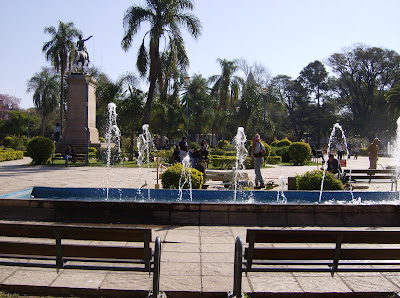
Pictures of Plaza 25 de Mayo


Here are some pictures of the 25 de Mayo Plaza, the main plaza in Resistencia. Check out the rest of my pictures: http://picasaweb.google.com/JoshEbener/Argentina


Monday, August 20, 2007

Greetings from Argentina


My blogs for the next year will mostly center around my seminary internship, which I’ll be doing in Resistencia, Argentina, with the ELCA (Evangelical Lutheran Church in America) Global Mission Horizon International Internship program. The internship is the third of four years for me in my studies (pursuing a Master of Divinity degree) at the Lutheran School of Theology at Chicago.

Greetings from chilly Argentina, where winter is finishing up, with temperatures in the 40s and 50s, and lots of clouds and rain. It may seem strange to those of you sweating in 90s and 100s that I broke out the winter coat, long underwear, and am clinging to a box heater. I am also sipping lots of mate, the classic Argentine tea, which I may actually like more than coffee.

Here’s the play-by-play of my last week… I left on Monday, August 13 from Chicago Ohaire to Washington DC, and that night I flew to Buenos Aires, arriving the next morning (Tuesday). I was picked up at the airport by the ELCA Global Mission South America regional directors and spent the day with their family. I was also able to meet the president and staff of IELU (Iglesia Evangelica Luterana Unida – United Evangelical Lutheran Church), and to see some of downtown Buenos Aires (see picture). It’s true that the city has a European feel. We walked past a political rally (no, I didn’t participate), which was for Cristina Kirchner, the wife of current president Nestor Kirchner, who seems to be the current front-runner for the presidential elections to be held in October (an exciting time to be here).

I took the bus that Tuesday night, which headed northward for 12 hours as I slept, and then arrived in Resistencia (where I’ll be living this year) Wednesday morning. Pastor Raul Gleim picked me up from the bus station and I spent the first two with him and his wife in their house. Then on Friday after last year’s YAGM (Young Adults in Global Mission) volunteer took off, I moved into the house where she stayed. It is a little house in the back yard of a very sweet elderly couple’s house, and in the front of the house is the church office.

The terrain is flat and swampy with tropical plants and lagoons. Resistencia, a city of roughly 400,000 people, is a city of sculptures of all sorts of styles. The city centers around a very large plaza, Plaza 25 de Mayo (25th of May), which is the actual Independence Day of Argentina (and also my birthday). The culture here is distinct, especially as compared to Buenos Aires. It’s more laid back and they have a nice siesta in the afternoons. This is the capital and main urban center of the Province of Chaco. Chaco is home to many indigenous people, who are an ostracized minority in the country. Chaco is also one of the poorest provinces in the country. There are many children throughout the province who suffer from malnutrition. Because of these realities, there are many people that migrate to the city and settle on the outskirts.

So far I have been getting acquainted with my pastor/supervisor, who along with the other people I’ve met, has been very warm and welcoming. I have already gotten to attend a worship service at Misión Maria Magdalena (Mary Magdalene Mission), which is on the outskirts of Resistencia. The church has been a driving force for, and partner with, many social programs in the neighborhood, and the pastor works with a couple of social workers. There are hot meals for children, after-school programs, health programs, and several other programs the church is involved with. The other church I’ll be with is in Corrientes, a city of about the same size, which is across the Parana river. I’ll be preaching at both churches next week.

That’s it for now, thanks for all of the prayers and support you all have offered me.